
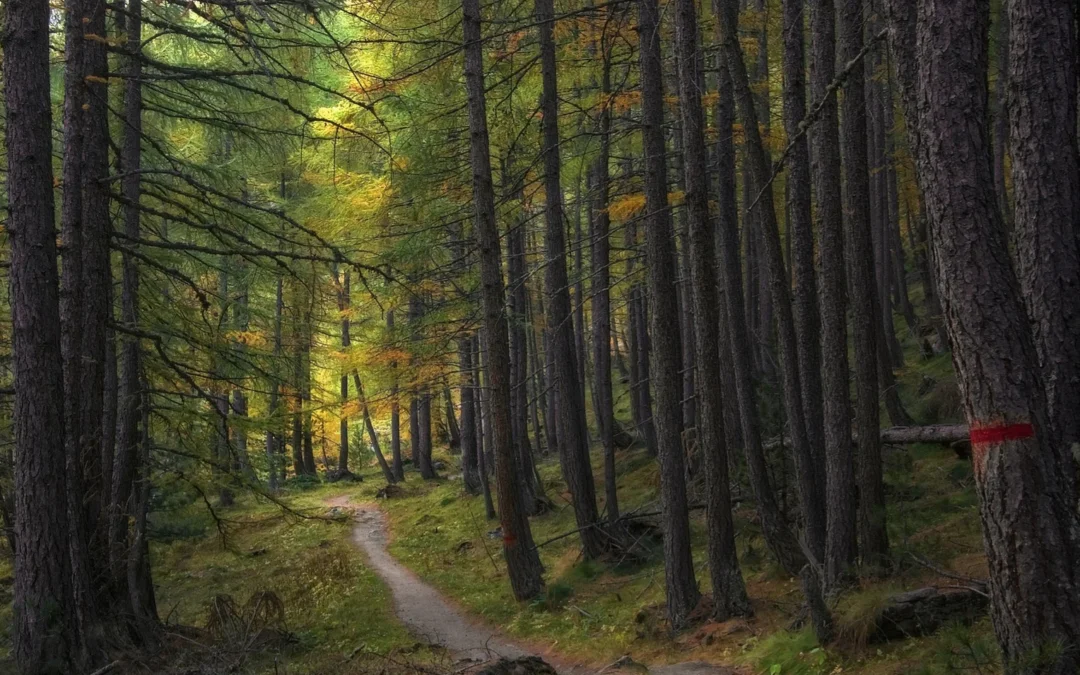
Entering the Dark Wood: When the Life You Have Been Living No Longer Fits
The poet David Whyte, translating a line from Dante, wrote:
In the middle of the road of my life I awoke in a dark wood where the true way was wholly lost.
Dante wrote those words in the fourteenth century, but the experience he is describing is not historical.
It is immediate. Personal. Recognisable.
Most people, at some point in their lives, will find themselves in that dark wood.
Not a forest. Not a metaphor for mild confusion or a difficult week.
A place where the life you have been living stops making sense. Where the assumptions you built everything on begin to loosen. Where the capable, directed, functioning person you have always understood yourself to be no longer quite fits the life they are being asked to live.
And the first response, almost universally, is to assume that something has gone wrong.
The world we live in does not know what to do with the dark wood
We live in a culture that values certainty, momentum, and the appearance of having things together.
From early on, most of us are shaped to solve, to fix, to keep moving. When life becomes uncertain, the instinct is to restore certainty as quickly as possible. Find the answer, make the plan and take the action.
And so, when the dark wood arrives, we tend to treat it as a problem.
A problem of attitude, perhaps, or of circumstance. Something, at any rate, that should not be happening and needs to be corrected.
But the dark wood is not always a problem.
Sometimes it is a place.
And there is a real difference between trying to escape a place and learning to enter it honestly.
What is actually happening
When I look back at my own dark wood, which arrived in my late thirties following the breakdown of my marriage, I can see now what I could not see at the time.
Something in my life had run its course.
The identity I had built, the roles I was playing, the version of myself I had constructed over many years, had begun to loosen. Not because I had failed, but because something deeper in me had outgrown it.
At the time, it felt like collapse.
Looking back, I recognise it as the beginning of a rite of passage.
This is something I encountered much more directly through my time in Southern Africa and in Peru, working alongside indigenous teachers and traditions that have held the knowledge of life transitions for thousands of years. In those traditions, what we tend to call a midlife crisis is understood very differently.
It is understood as a threshold.
A point at which the person someone has been can no longer contain who they are being asked to become. The old structure loosens, sometimes painfully, to make room for something more true.
The dark wood, in this understanding, is not a malfunction.
It is the beginning of an initiation.
What the body already knows
There is something worth paying attention to here that goes beyond thought.
The dark wood does not only live in the mind, it lives in the body.
It may be the particular quality of tiredness that sleep does not touch. The heaviness that settles on a Sunday evening without obvious cause. The strange flatness that arrives after something you worked hard for, achieved, and found somehow not enough. The moment mid-conversation when you hear yourself say words that are true but no longer feel alive.
The body registers this before the mind can name it.
And in many of the traditions I have worked with, this registering is itself understood as intelligence. Not a symptom to be managed, but a signal worth attending to.
Something in you already knows.
The ground is shifting. Something deeper is beginning to speak.
This matters, because we live in a culture that is so oriented towards analysis and solution that we often talk ourselves out of what the body is quietly, persistently trying to say.
I am tired in a way I cannot explain. Something is missing, but I cannot name it. This life looks right from the outside, but something in me does not believe it.
These are not failures of gratitude or perspective.
They are the first language of the dark wood.
And they deserve to be taken seriously.
Why this is not where you are lost
David Whyte has written about how the dark wood is not the place where the journey ends.
It is the place where a more honest journey begins.
The old path, however, carefully followed, has brought you here. And here, the old map stops working. The old certainties lose their authority and the old version of who you are begins, slowly, to loosen its grip.
That can feel terrifying.
It can also, in time, feel like relief.
Because something cannot emerge while our hands are still full of what no longer fits. Something cannot begin while we are still insisting that the path we have been on must be the right one, simply because it is the one we have always known.
The dark wood asks for a different kind of attention.
Less control, more honesty, less performance and more listening.
It asks us to stay present long enough for something more real to begin to take shape.
That is rarely comfortable. But it is, for those willing to enter it honestly, one of the most important places a human life can arrive at.
A reflection to sit with
Where in your life do things feel less certain than they once did?
Not as a problem to fix, but just as something to acknowledge.
Because sometimes what appears to be falling apart is not falling apart at all.
Sometimes it is the beginning of something more true trying to find its way through.
And sometimes the dark wood is not where you are lost.
It is where a different path begins.